Overview
Beginning in 2023, Southeast Conference (SEC), on behalf of the Alaska Mariculture Cluster (AMC), began issuing subawards and contracts to complete projects that are helping to catalyze the mariculture industry in Alaska. These grant component projects are led by economic development districts, seafood industry associations, universities, and Alaska Native community financial institutions throughout the region, and AMC’s investments are providing funds for projects in workforce development, research, equipment and technology, marketing, low-cost capital, and more.
To capture the grant’s impact, SEC is working with the nonprofit Ecotrust, who is serving as AMC’s grant evaluator. Ecotrust, a nonprofit based in Portland, OR, is helping AMC refine its methods and metrics to achieve the grant’s objectives, as well as helping to understand industry reach, track success, and maximize effectiveness of each component project. AMC’s activities and projects have contributed positively to the mariculture industry in Alaska, strengthening relationships, trust, and partnerships in pursuit of a strong and tenable industry.
Ecotrust is applying a methodology for evaluating the AMC grant, which began with with developing a theory of change and indicators. Their team performs document review, data analysis, interviews, focus groups, and surveys. SEC meets regularly with Ecotrust to stay engaged and learn from the ongoing evaluation while administering grant programs. Externally, Ecotrust has presented updates on the grant evaluation process to the AMC Governance Body, AMA Liaisons, and regional EDDs, as well as presentations at the Mariculture Conference of Alaska. In November 2025, Ecotrust presented at a webinar to share information about their work-to-date. In March 2026, SEC will publish Ecotrust’s formative evaluation report on AMC grant activities in 2024 and 2025.
Theory of Change
The Theory of Change is a resource that outlines and explains how each project component contributes to AMC’s overarching goals of increasing industry innovation and expediting private investment into Alaska’s mariculture industry. The Theory of Change was created collaboratively by SEC and Ecotrust and is based on series of outcome maps for each project component. The Theory of Change summarizes AMC’s strategic approach to sustained, long-term industry transformation and serves as a roadmap for project outcomes.

Indicators
In Q1-Q2 2024, Ecotrust, SEC, and the subawardees developed a list of Indicators for each AMC Grant Component, which Ecotrust uses to track progress toward AMC’s goals. These Indicators are largely quantitative and range from, for instance, “number of workshop/training participants?” to “number of communities engaged” and from “number of findings and reports shared?” to “increase in numbers of farmers supplied with seed?” to name a few. The Indicators help Ecotrust carefully and strategically track preliminary grant activities, building a strong framework for deeper analysis when paired with more qualitative approaches (focus groups, interviews) in other areas of the methodology.

Industry Challenges
Ecotrust & SEC collaborated to create a list of the most pressing challenges facing Alaska’s mariculture industry. The AMC grant programs and projects are designed to address these challenges:
Interviews & Surveys
Ecotrust is engaging in a series of semi-structured interviews with industry experts and community leaders to understand perceptions of AMC’s impact and identify key themes related to AMC’s achievements in addressing key industry challenges. To prepare for these interviews, Ecotrust engaged in 10+ meetings with staff from SEC, AMC subawardees, and regional liaisons and in informal conversations with regional mariculture leaders, including leaders of regional nonprofits, ANCs, mariculture farmers, and AMC Governance Body members, including Tribal representatives.
So far, interviews have been conducted with mariculture industry experts and community leaders across the AMC’s four regions: Kenai Peninsula, Prince William Sound, Southeast Alaska, and Southwest Alaska. These interviews were conducted with RFP awardees, Governance Body members, participants in workforce development or training programs, and kelp and oyster farmers, and current or former liaisons, allowing for a wide range of perspectives, opinions, and experiences.
Alaska Native and rural community members are well represented in interviews to-date. More than half of interviewees worked for an Alaska Native-led organization (Tribal entity, ANC, AK Native-led nonprofit, and/or AK Native-led small business), and more than a third are Alaska Native tribal citizens. The majority of Ecotrust’s interviewees live primarily in a rural area (outside Anchorage, Juneau, Fairbanks, or Ketchikan), and most of the remainder live in Anchorage but work for a rural-based organization.

Focus Groups
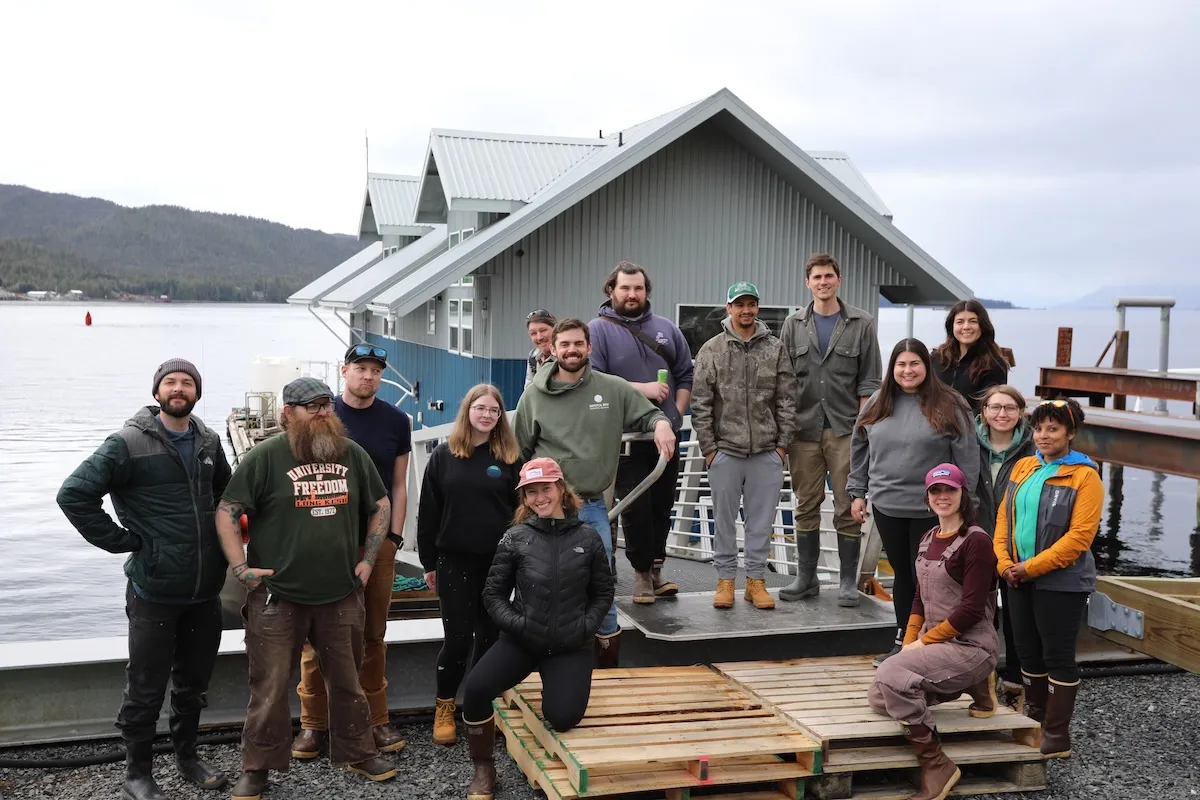
Focus groups allow for the possibility of discussion and the inclusion of multiple perspectives, as well as sharing common experiences. In summer 2025, Ecotrust held a focus group with 12 regional mariculture leaders from across the Kodiak Archipelago, the majority of whom were Tribal citizens and/or worked for Tribal government departments or ANCs. The focus group was successful and provided valuable insight into AMC projects and activities, and Ecotrust is organizing more focus groups in the Kenai Peninsula, Prince William Sound, and Southeast regions.
Document Review & Data Analysis
To understand the progress of AMC toward its goals and outcomes, Ecotrust is reviewing robust documentation and data on AMC programs, projects, and grant components. This documentation includes outward-facing products like RFPs created by SEC and AFDF, including RFP project overviews and interim and final reports submitted to SEC and published on the AMC website. It also includes internal documentation like semiannual reports to the Economic Development Administration (EDA) for each grant component, written and submitted by SEC. Such detailed familiarization with AMC’s subaward and contractor projects allows for an accurate and up-to-date evaluation process.
AMC Targets
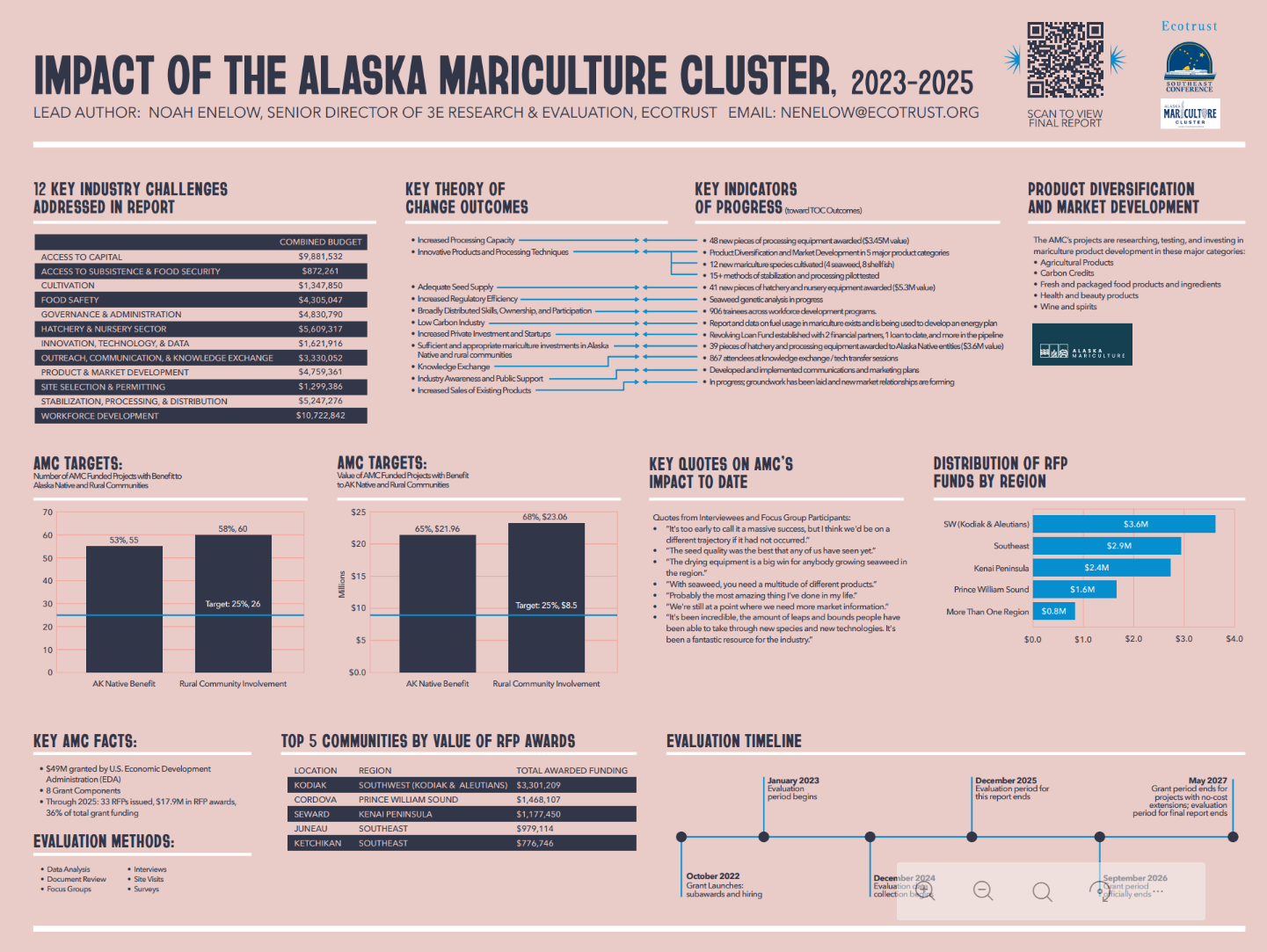
Growing and strengthening Alaska’s mariculture industry provides an opportunity for transformative economic development, and many Alaska Native and rural communities will benefit the most from this mariculture-led economic development. Therefore, at the grant’s outset, AMC set targets for reaching Alaska Native and rural communities: 25% of grant resources to benefit Alaska Native communities, and 25% to benefit rural communities. SEC classifies all AMC-funded projects based on whether they benefit Alaska Native populations and/or rural Alaskan communities.
As of December 2025, AMC is on track to exceed its targets of 25% of projects to benefit Alaska Native populations and 25% of projects to benefit rural Alaskan communities. As demonstrated below, 50% of AMC-funded projects meet the criteria above for benefiting Alaska Native populations, while 53% meet the criteria above for benefiting rural Alaskan communities.


Reports
2023 – 2025 Evaluation Report
Using the methodology described above, in March 2026, Ecotrust released the AMC 2023-2025 Evaluation Final Report. This 70-page report presents a formative evaluation of the AMC grant activities conducted from 2023 to 2025. It explains how SEC and its partners have deployed grant funding across Alaska to support workforce development, research, equipment and technology, marketing, access to capital, and other initiatives designed to grow the mariculture industry. The evaluation examines the grant’s early impacts by analyzing program data, stakeholder feedback, and project outcomes. Readers will gain insight into how AMC’s investments are strengthening partnerships, supporting industry participants, and helping build the foundation for a sustainable mariculture sector in Alaska.
Poster: Impact of the Alaska Mariculture Cluster
In addition to the report, Ecotrust created a poster for the 2026 Mariculture Conference of Alaska. This poster summarizes many of the highlights of the work done during the evaluation process, including key connections between the Theory of Change and Indicators of Progress.
Executive Summary: 2023 – 2025 Evaluation Report
Click below to read