
Overview
Through the Alaska Fisheries Development Foundation (AFDF) subaward, the Alaska Mariculture Cluster (AMC) has funded an ambitious seaweed tissue analysis program to better understand the potential uses of Alaska’s kelps and other native seaweeds. These studies provide critical insights into nutritional content, valuable bioactive compounds, processing potential, and quality assurance.
In 2024, an analysis of more than 100 wild-source samples across 15 species examined the composition of the seaweeds, including nutrients, carbohydrates, bioactives, vitamins, and trace elements. In 2025, another compositional analysis was conducted on more than than 30 samples across 5 species, this time focusing on farmed kelps.
To learn more about each project, click here:
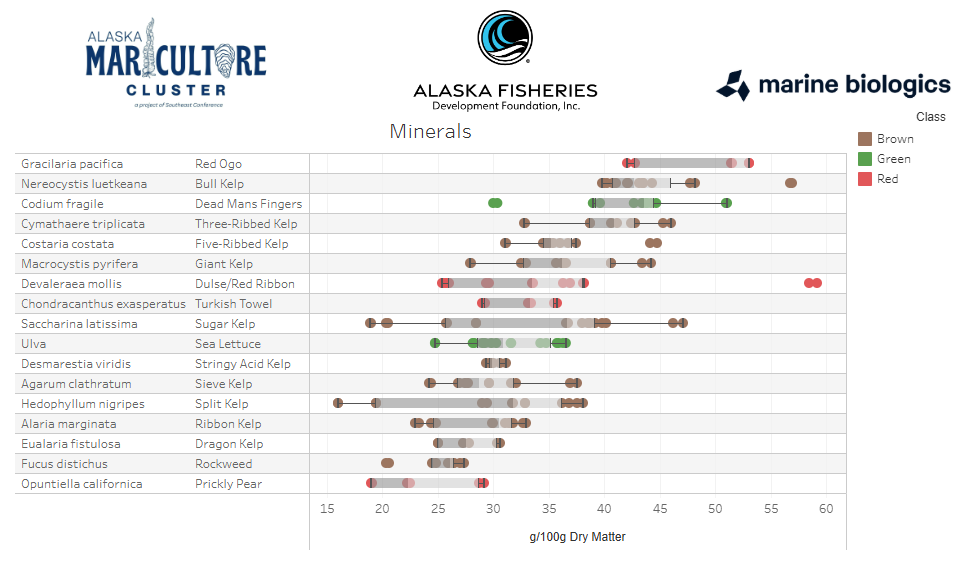
2024: Dashboard and Report | Laboratory Analysis of Samples From 15 Wild-Source Seaweed Species
Region: All Regions
Species: Agarum clathratum (sea colander); Alaria marginata (winged kelp); Chondracanthus exasperates (turkish towel); Codium fragile (dead man’s fingers); Costaria costata (five-ribbed kelp); Cymathaere triplicata (three-ribbed kelp); Desmarestia viridis (stringy acid kelp); Devaleraea mollis (dulse); Eualaria fistulosa (dragon kelp); Fucus distichus (rockweed); Gracilaria pacifica (red ogo); Hedophyllum nigripes (brown lacy kelp); Macrocystis pyrifera (giant kelp); Nereocystis luetkeana (bull kelp); Opuntiella californica (prickly pear); Saccharina latissima (sugar kelp); Ulva spp (sea lettuce).
This foundational study focused on analyzing the nutritional composition, carbohydrate content, and bioactive compounds in wild-source Alaskan seaweeds. Celignis conducted extensive testing on samples around the state in May and June 2024, with 40 analyses per sample. Using advanced laboratory techniques, Celignis then performed more than 40 different analyses per sample, assessing everything from basic macronutrients to specialized metabolites such as fucoidans, alginates, and phlorotannins.
Drawing on expertise in seaweed chemistry, data science, and market development, the Marine Biologics team developed this interactive dashboard to make the 2024 analysis more accessible to farmers, processors, researchers, and policymakers. This dashboard enables users to explore chemical and functional profiles across species and to identify high-potential market applications and opportunities for Alaska’s growing seaweed industry. Marine Biologics also produced a comprehensive report with the results of the analysis. This 46-page report provides detailed information about the analysis, with information about methodology, scientific context, and specific nutritional profiles.
This research is vital for identifying high-value compounds that could support Alaska’s food, agriculture, cosmetics, and biotechnology industries.
2025: Dataset | Laboratory Analysis of Samples From 5 Farmed Seaweed Species
Region: All regions
Species: Alaria marginata (winged kelp); Cymathaere triplicata (three-ribbed kelp); Nereocystis luetkeana (bull kelp); Saccharina latissima (sugar kelp); Hedophyllum nigripes (split kelp).
In 2025, kelp farms from around Alaska sent over 30 total samples of their products to be analyzed for information on their nutritional, mineral, metal, and saccharide contents. This data was then organized into a publicly-accessible, downloadable spreadsheet that contains information on 34 different compounds throughout five kelp species. The data includes measurement averages and standard deviations to allow for an accurate and informed understanding of farmed seaweed composition.
This project helps farmers, processors, and policy makers make informed decisions about which species hold the most commercial promise. The 2025 analysis is expected to guide future seaweed tissue research, inform regulatory strategies, and further position Alaska as a leader in sustainable seaweed production.
Button will download an Excel file
University of Alaska Fairbanks
Carbohydrate Content in Alaska Kelps
Funding: $20,000
Region: Prince William Sound
Species: Bull kelp, ribbon kelp, sugar kelp
A separate project from the two described above, this study – a master’s thesis project by a University of Alaska Fairbanks student – examined polysaccharides concentrations in farmed kelp in Alaska. These carbohydrates are a focus of several seaweed processing startup companies, with applications in health supplements, medicine, and other markets. This study assessed the relative abundance of four carbohydrates (glucan, mannitol, alginate, and fucoidan) in bull, ribbon, and sugar kelp. AMC funds supported purchases of cultivated kelp, sampling supplies, and lab services. Cameron Jardell, lead researcher at UAF, continues to be involved in development of Alaska mariculture industry and currently works on kelp gametophyte seeding research at the Chugach Regional Resources Commission in Seward.
Interim Update [Pending]
Final Report [Pending]
