
Search AMC News
AMC Monthly Update: May and June 2026
June 30, 2026
Lead Entities: Southeast Conference
Grant Component: Grant Administration
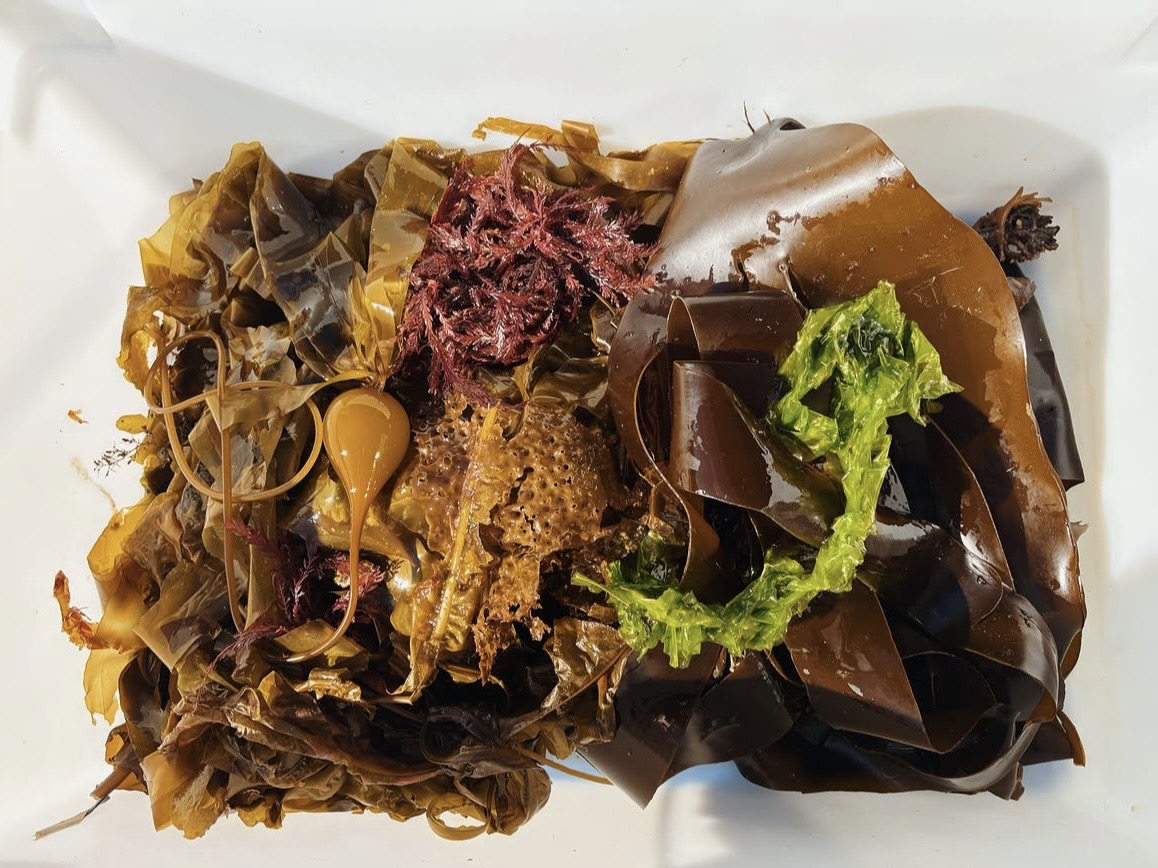
In 2026, the Alaska Mariculture Cluster (AMC) continues its work to strengthen the mariculture industry in Alaska. Each of the grant’s component projects is progressing steadily, and the coalition is working to catalyze the industry for the long-term benefit of Alaska’s economy, environment, and communities. As the grant enters its final year, stay up to date on programs and projects by clicking below to read more.
Component #1: Revolving Loan Fund
The RLF addresses lending barriers within the mariculture industry by offering collateral support to lending institutions for borrowers who do not qualify for traditional loans. Mariculture businesses can apply for loans with Northrim Bank and Spruce Root.
With funding awarded from the AMC’s Mariculture Business Planning Tools RFP, Seamark Holdings, an Alaskan consulting firm, will offer business planning services and technical assistance to shellfish farmers and mariculture processors across Alaska. Seamark joins a growing network of organizations providing mariculture business development support. Its work will complement existing services from GreenWave, which works with seaweed nurseries, farms, and processors, and Spruce Root, which provides business planning and technical assistance related to financing, loan applications, and production strategies. Together, these providers expand loan readiness and access to business resources across Alaska’s diverse mariculture sectors through the Mariculture Business Planning Program.
Component #2: Governance, Coordination, & Outreach
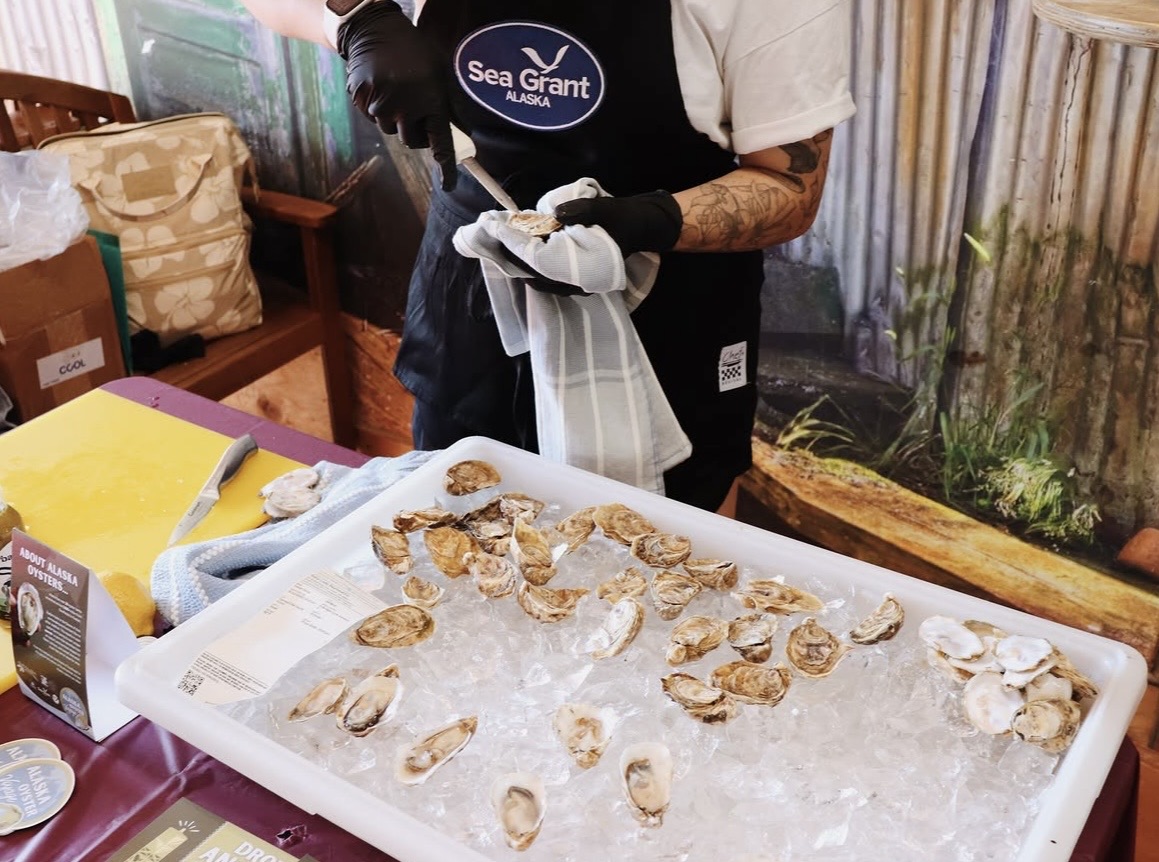
In May, SEC tabled an exhibition booth at the Juneau Maritime Festival to increase industry awareness and drive local sales for mariculture products. Sea Quester Farms, a Juneau-based seaweed farm, served over 400 kelp-salmon burger samples. Additionally, SEC was joined by regional oyster farms – Salty Lady Seafood Co and Tomasso Shellfish – and Alaska Mariculture Research & Training Center staff to shuck and provide samples of 40 dozen oysters from farms across Southeast Alaska. The event was widely attended by locals and tourists, who were encouraged to purchase oysters by the dozen from restaurants, retailers, and directly from farmers.
In June, SEC traveled to Kodiak for the Kodiak Kelp Festival, led by Alaska Sea Grant. Hosted at the Kodiak Seafood and Marine Science Center and throughout Kodiak, the festival highlighted the people and businesses behind seaweed farming in the Kodiak Archipelago and across the state. The week was full of kelp-themed trivia, crafting, science, cooking, and exploration, allowing participants to learn about Alaska’s unique seaweeds and Kodiak’s growing mariculture industry. The event helped to emphasize how kelp is shaping Alaska’s environmental and economic future.
Also in June, AMC attended the Phycological Society of America annual meeting in Juneau, connecting with research partners and presenting on the grant’s programs and successes. The PSA annual meeting provided valuable opportunity to learn about national seaweed research, including multiple presentations by AMC partners and AMC-funded projects, including Kelp Ark and University of Alaska Fairbanks’ (UAF) Pacific dulse research. AMC continues to engage in seaweed- and shellfish-related outreach opportunities and to support innovative research that will help grow Alaska’s mariculture industry.
Component #3: Workforce Development
The AMC’s Workforce Development program is primarily led Alaska Sea Grant at UAF, University of Alaska Southeast (UAS) Sitka, and the University of Alaska Anchorage (UAA) Prince William Sound College. All three institutions have trainings, workshops, and college courses offered in their region and UAF / Alaska Sea Grant has statewide coverage. SEC is finalizing budget revisions with its university partners.
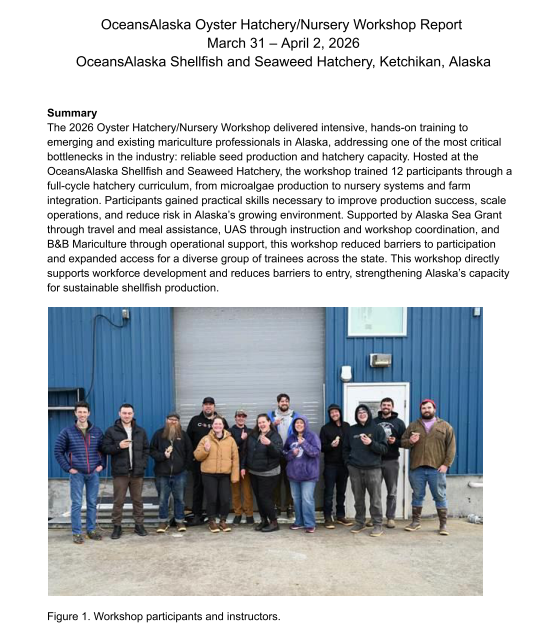
The final report for OceansAlaska’s Hands-On Farm Training project was published in May on the AMC website. This workshop provided comprehensive, hands-on training across the full hatchery and farming cycle, including microalgae production, broodstock conditioning, spawning, larval and seed rearing, nursery techniques, and Alaska-specific farming methods. Learn more about the other Hands-On Farm Training projects on the new project page.
Click below to read the Hands-On Farm Training Report:
Component #4: Research & Development
Research and Development activities under Component Project #4 continue to expand as AMC-supported projects move from initial testing toward broader industry application and data sharing. Researchers funded by the Seaweed Tissue Analysis Program have launched a new database, making results from seaweed testing projects more accessible to farmers, researchers, and industry stakeholders. The dashboard compiles data on nutritional composition, bioactive compounds, carbohydrates, food safety, and other characteristics of Alaska-grown seaweeds, helping support product development and market opportunities across the industry.
Within the Kelp Agriculture Product Development & Testing Program, Pacific Kelp Company received an additional $40,000 to conduct comparative testing of the three Alaska kelp-based biostimulants developed through this AMC-funded program. The trials will evaluate product performance on the same crops and benchmark results against conventional non-kelp biostimulant products, helping identify opportunities for agricultural use of Alaska-grown kelp. GreenWave also received additional AMC funding to support the purchase of intermediate bulk containers (IBCs), enabling participating seaweed farmers to process and store greater volumes of kelp-derived biostimulant products.
Research efforts under the Carbon Sequestration Program also continue to generate new findings. Kelson Marine recently published a quarterly progress report on its Carbon Sequestration project. The report summarizes project activities completed to date and outlines ongoing efforts to better understand the role cultivated seaweed may play in carbon sequestration. Together, these activities continue to strengthen the scientific foundation needed to support the long-term growth and diversification of Alaska’s mariculture industry.
Component #5: Market Development
The AMC Marketing Program, which is collaboratively managed by AMA and SEC, continues to make impactful progress towards driving demands for Alaska’s mariculture industry. In mid-May, Tastemaker Comms and Rising Tide Communications welcomed a group of four journalists to Cordova for the second familiarization (FAM) trip, an immersive experience connecting these writers directly with Alaska’s mariculture industry. Through site visits, product tastings, and scenic hikes, participants who write for National Geographic, Martha Stewart, Delish, Eater, The Kitchn, and AgTech Navigator gained a firsthand understanding of Alaska’s unique and growing industry. A full trip recap was published on the AMC website.
In early June, another FAM trip took place in Juneau, with another group of participants travelling to Southeast Alaska to see the growing industry across the region. These participants were able to meet with Juneau- and Hoonah- based kelp and oyster farmers, visit farms, taste mariculture products, and take in the beauty of Southeast Alaska. A full trip recap will be published soon.
Component #6: Green Energy
The GEM project continues to collaborate with the AMC-funded kelp dryer in Cordova and log its energy usage with a 3-phase electric power meter The GEM team will use this data to model energy use of other kelp drying methods using other data from around the state and will work to create a report about energy use in kelp processing.
Component #7: Equipment & Technology
Kelp Ark continued expanding its collection of Alaska kelp gametophytes and has now successfully isolated more than 570 unique gametophyte strains from sugar, ribbon, and bull kelp collected across multiple growing regions. The project is advancing the development of a long-term gametophyte bank that will help preserve genetic diversity, support future seed quality improvements, and provide a valuable resource for Alaska’s growing kelp farming industry.
Furthermore, the Other Mariculture Species Program has newly published reports from the Pacific Shellfish Institute’s Geoduck project (Nursery Checklist, Quarterly Report) and UAF’s Pacific Dulse project (Quarterly Report). Additionally, the Alaska Oyster Cooperative published its feasibility study’s final report for a Naukati-based processing hub, providing a roadmap for developing shared oyster processing and distribution infrastructure that can help improve efficiency, expand market access, and support continued growth in Alaska’s shellfish sector. AMC’s economic research services, conducted by McKinley Research Group, also recently released its Spring 2026 Memo, which updates 2025 and 2026 harvest estimates and forecasts, based on 2025 farm annual report data published by the Alaska Department of Fish and Game (ADF&G) in spring 2026.
SEC also continues to work on finalizing funding for previous rounds of equipment awards and has been working with existing subaward recipients to finalize purchasing documents, receive EDA approval, and process invoices for reimbursement. SEC continues to update the AMC website and the Mariculture Equipment Airtable Database with published materials, including final reports, interim project updates, and equipment reimbursement status.
Component #8: Grant Management
SEC recently launched a new timeline tool that tracks reports, presentations, and other updates chronologically on one webpage. AMC its partners regularly publish reports, updates, papers, presentations, videos, and other resources that highlight the ongoing work, partnerships, and impacts of the grant coalition. These resources range from short progress updates to long, comprehensive final reports and provide valuable information about mariculture research and AMC programmatic activities throughout Alaska.
About the Alaska Mariculture Cluster
Southeast Conference (SEC) is the federally designated Economic Development District (EDD) for Southeast Alaska, as well as the state designated Alaska Regional Development Organization. SEC’s mission is to undertake and support activities that promote strong economies, sustainable communities, and a healthy environment in Southeast Alaska.
In September 2022, Southeast Conference was awarded a $49 million U.S. Economic Development Administration (EDA) Build Back Better Regional Challenge (BBBRC) grant to catalyze a viable and sustainable mariculture industry in Alaska, supporting the production of shellfish and seaweed, for the long-term benefit of the state’s economy, environment, and communities.
SEC leads the Alaska Mariculture Cluster (AMC) grant coalition, which includes members of Alaska’s mariculture industry, tribal organizations, regulatory agencies, university system, regional EDDs, trade organizations, and others. A Governance Body, composed of AMC coalition leaders and Tribal executives from each of the project regions, guides the grant’s work and equity metrics.
The AMC has complementary grant components designed to break down barriers and develop Alaska’s mariculture industry. The Overarching Narrative explains how the grant components work together to grow the industry in an equitable and responsible manner. The full project period for the Alaska Mariculture Cluster is October 1, 2022 to September 30, 2026, though some projects may be extended up until May 28, 2027.
