
Search AMC News
AMC Monthly Update: January 2026
January 15, 2026
Lead Entities: Southeast Conference
Grant Component: Grant Administration

As 2026 begins, the Alaska Mariculture Cluster (AMC) continues its work to strengthen the mariculture industry in Alaska. Each of the grant’s component projects is progressing steadily, and the coalition is working to catalyze the industry for the long-term benefit of Alaska’s economy, environment, and communities. As the grant enters its final year, stay up to date on programs and projects by clicking below to read more.
Component #1: Revolving Loan Fund
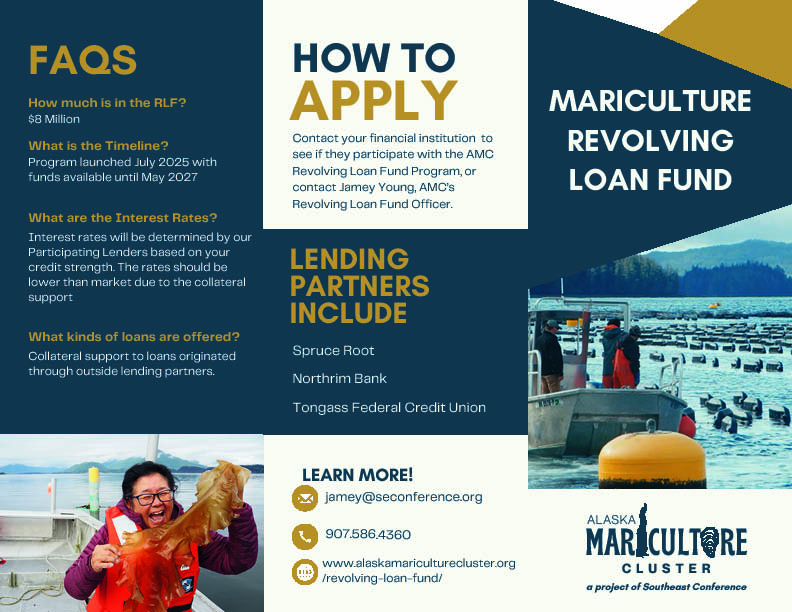
The AMC’s Revolving Loan Fund (RLF) program is processing its first loan application. The RLF addresses lending barriers within the mariculture industry by offering collateral support to lending institutions for borrowers who do not qualify for traditional loans and by leveraging capital to support rural and distressed communities. The RLF program added Northrim Bank as an approved lending partner. Borrowers may now apply for a RLF loans with Northrim Bank or Spruce Root.
AMC’s RLF complemented the Alaska Mariculture Alliance’s Mariculture Incentive Grant Program (MIGP), which recently closed its third and final funding round on December 15, 2025. MIGP applicants must satisfy a 1-to-1, dollar-for-dollar match through cash or loans, and loans secured through AMC’s Revolving Loan Fund (RLF) satisfy this requirement.
Component #2: Governance, Coordination, & Outreach
SEC continues to work closely with the Alaska Mariculture Alliance (AMA), attending board meetings and participating in two biweekly meeting series: one with AMA, regional Mariculture Liaisons and the EDDs (KPEDD, PWSEDD, and SWAMC); one with just AMA and the regional Mariculture Liaisons. SEC has assisted AMA with forecasting and budgeting its remaining AMC subaward funds.
KPEDD, PWSEDD, SEC, and SWAMC – the regional EDDs receiving AMC funding – continue to work with industry partners, stakeholders, and AMA Liaisons to facilitate communication, events, and project development. SWAMC is assisting the newly hired Aleutians Liaison in outreach training and strategy. All other EDDs are working closely with their regions’ mariculture organizations and liaisons, including planning community mariculture events for Summer and Fall 2026. These events will be supported by AMA, SEC, and the AMC Marketing Program as well.
Component #3: Workforce Development
The AMC’s Workforce Development program is primarily led by the University of Alaska Fairbanks (UAF) Alaska Sea Grant, University of Alaska Southeast (UAS) Sitka, and the University of Alaska Anchorage (UAA) Prince William Sound College. All three institutions have trainings, workshops, and college courses offered in their region and UAF / Alaska Sea Grant has statewide coverage. SEC has been finalizing budget revisions with its university partners and is developing case studies to highlight program successes and impacts.
SEC has selected three organizations for its Hands-On Farm Training Program and is currently finalizing contracts with each: AMA, OceansAlaska, and Kodiak Ocean Growers. Together, these partners will complement existing university-led training programs and support paid internship placements at oyster and seaweed farms across Alaska.
Component #4: Research & Development
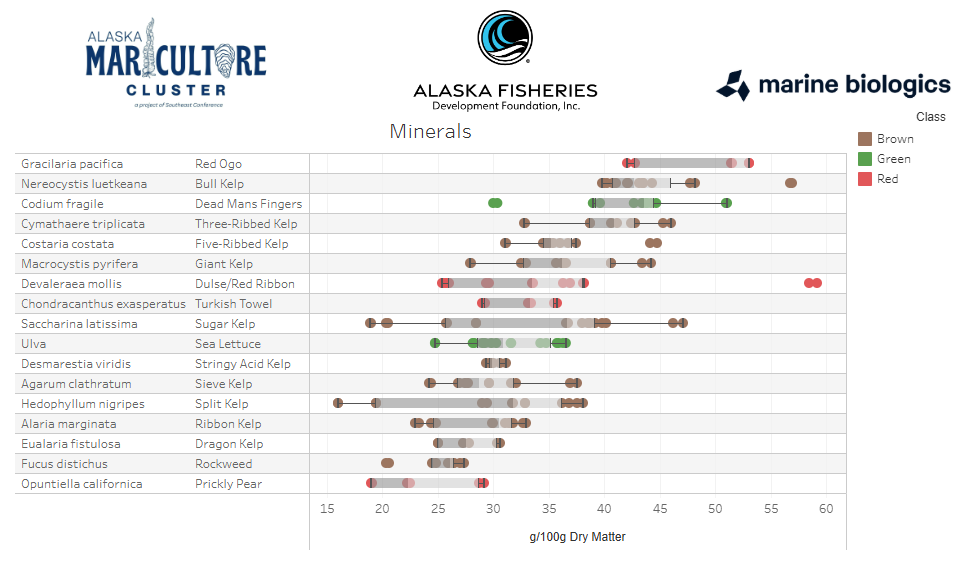
Across all programs, Fall 2025 marked a period of synthesis, data processing, and preparatory work ahead of major milestones expected early in 2026. Within the Seaweed Tissue Analysis Program, a draft report on 2024 tissue analysis results has been completed, and analysis of 2025 testing results has begun and will be complete in the next few months. The Carbon Sequestration Program, which announced awarded projects in October 2025, is underway, with projects expected to provide their first updates soon. Work has steadily continued on oyster seed transfer trials and Alaska Department of Fish and Game’s (ADFG) population genetics program, with SEC currently undergoing a budget revision with ADFG to maximize their impact in 2026. Additionally, in the Liquid Kelp Biostimulant Product Refinement and Field & Market Testing project, Kachemak Kelp’s plant biostimulant samples were sent to the lab and will be integrating the results with data from root growth experiments and on-farm vegetable trials.
Additionally, Alaska Fisheries Development Foundation (AFDF) continued advancing the Joint Innovation Projects as interim and final reports were received from awardees. Following a review of project budgets, AFDF launched a third and final round of JIP funding, focused specifically on product development, with individual awards capped at $50,000. Organizations are expected to be selected this month.

Component #5: Market Development
The AMC Marketing Program continued to be highly active and impactful. The contractors, Tastemaker Comms and Rising Tide Communications, brought more national media coverage through the first Familiarization Trip in Anchorage, Homer and Kachemak Bay. Post-trip coverage and social media content is boosting visibility for Alaska kelp and oysters with over 18.67 million media impressions logged to date.
SEC and AMA are collaborating to administer this contract and are working to increase program budget and scope of work to include additional trade shows, FAM trips, sampling programs, and promotion of AMC’s various kelp agriculture product research and development efforts in the biostimulant space. Brand logos were developed and recently presented to the advisory panels for seaweed and shellfish. These brand assets will be used for future collective marketing activities, merch, packaging materials, and other campaigns.
Additionally, SEC continued working with Retra LLC on Prop 65 sampling plan refinement. The project is still undergoing technical review to determine testing feasibility and implementation options.
Component #6: Green Energy
The AMC’s Green Energy in Mariculture (GEM) Project released a report analyzing how Alaska’s mariculture industry uses energy and how it can transition toward cleaner, more efficient power sources. The study lays the groundwork for a more energy-efficient mariculture sector that minimizes reliance on fossil fuels. Key findings include: Average farm size: 45,000 pounds harvested annually with five workers per site. Travel patterns: Farmers visit their sites 113 times per year on average, typically traveling six nautical miles by boat at 21 knots. Fuel consumption: 75% of respondents use gasoline (848 gallons per year on average) and 25% use diesel (1,043 gallons). Power sources: 60% rely on generators at their remote site, 55% use energy from their vessels, and 10% connect to local electric grids.
Component #7: Equipment & Technology
A scoring committee has reviewed the third and final round of proposals for the Mariculture Equipment Program. Through SEC’s ongoing budget revision efforts with subaward recipients and contractors, SEC was able to increase the total available funding for round 3 by roughly $1.5 million, which will allow the scoring committee to award additional equipment.
SEC continues to work with McKinley Research Group and the Pacific Shellfish Institute to provide AMC and the broader mariculture industry with current information about topics including oyster and seaweed harvest, farm utilization, seed supply and quality, and growing techniques. The second of three annual reports was recently published. SEC is also amending a contract with Hatch Blue to continue Alaska Mariculture Insights development and improvements through the end of the grant.

Component #8: Grant Management
As the AMC grant approaches its conclusion, SEC issued a Succession Planning RFP for qualified contractors to help plan for the continuation of key programs, partnerships, and grant impact beyond the life of the grant. This succession plan will help identify areas of need within Alaska’s mariculture industry and create preliminary strategies to address these financial, programmatic, or structural gaps. SEC is seeking a motivated and organized partner with knowledge of the AMC grant activities who can present a strongly written legacy pathway with actionable steps that will outline methods of support for Alaska’s seaweed and shellfish farming industry beyond the grant period.
Background
Southeast Conference (SEC) is the federally designated Economic Development District (EDD) for Southeast Alaska, as well as the state designated Alaska Regional Development Organization. SEC’s mission is to undertake and support activities that promote strong economies, sustainable communities, and a healthy environment in Southeast Alaska.
In September 2022, Southeast Conference was awarded a $49 million U.S. Economic Development Administration (EDA) Build Back Better Regional Challenge (BBBRC) grant to catalyze a viable and sustainable mariculture industry in Alaska, supporting the production of shellfish and seaweed, for the long-term benefit of the state’s economy, environment, and communities.
SEC leads the Alaska Mariculture Cluster (AMC) grant coalition, which includes members of Alaska’s mariculture industry, tribal organizations, regulatory agencies, university system, regional EDDs, trade organizations, and others. A Governance Body, composed of AMC coalition leaders and Tribal executives from each of the project regions, guides the grant’s work and equity metrics.
The AMC has complementary grant components designed to break down barriers and develop Alaska’s mariculture industry. The Overarching Narrative explains how the grant components work together to grow the industry in an equitable and responsible manner. The full project period for the AMC BBBRC project is October 1, 2022 to September 30th, 2026.
